
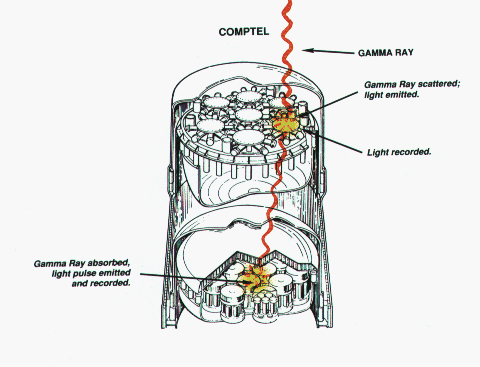
The two detector assemblies are separated by a distance of 1.5 m. Each detector is entirely surrounded by a thin anticoincidence shield of plastic scintillator which rejects charged particles. On the sides of the telescope structure, between both detectors, are two small plastic-scintillator detectors containing weak 60-Co sources, used for in-flight calibration of the instrument. Each calibration source consists of a cylindrical piece of 60-Co-doped plastic scintillator of 3 mm thickness and 1.2 cm diameter viewed by two 1.9 cm-diameter photomultiplier tubes (PMTs).
The Upper Detector (D1) consists of 7 cylindrical modules of liquid scintillator NE 213A. Each module is 27.6 cm in diameter, 8.5 cm thick, and viewed by eight photomultiplier tubes. The total area of the upper detector is approximately 4188 cm2. The Lower Detector (D2) consists of 14 cylindrical NaI(Tl) blocks of 7.5 cm thickness and 28 cm diameter, which are mounted on a supporting baseplate. Each block of NaI is viewed from below by seven photomultiplier tubes. The total geometrical area of the lower detector is 8620 cm2. Each anticoincidence shield consists of two 1.5 cm-thick domes of plastic scintillator NE 110, with each dome viewed by 24 photomultiplier tubes. With the exception of the front-end electronics, all detector electronics are mounted on a platform outsid e the detector assembly.
Primary Modes for the Acquisition of Scientific Data.
Double-Scatter Telescope Mode.
COMPTEL operates primarily as a double-scatter gamma-ray telescope.
In this mode an incident cosmic gamma-ray is electronically identified
by a delayed coincidence satisfying time-of-flight criteria between
the upper and the lower detectors, combined with the absence of a
signal from all charged particle shields and from the calibration
detectors. Gamma-ray events are initially screened on board the
spacecraft according to coarse pulse-height, time-of-flight, and
charged-particle veto limits, which are applied to reject background
events. The data are transmitted in telemetry packets where events
satisfying all selection criteria (referred to as "Gamma 1" events)
have first priority for transmission in the telemetry stream, followed
by events selected according to a secondary set of onboard criteria
("Gamma 2" events). The telemetry rate of 6125 bits per second
permits the transmission of approximately 20 events per second from
the spacecraft.
The quantities measured for each selected gamma-ray event are:
Burst Mode
In addition to the normal double-scatter telescope mode of operation,
two of the NaI crystals in the lower D2 detector assembly of COMPTEL
are also operated simultaneously as burst detectors. These two
modules are used to measure the time history and energy spectra of
cosmic gamma-ray bursts and solar flares. The burst detector modules
are equipped with a dedicated electronic subsystem,
the Burst Spectrum Analyser (BSA).
One of the burst modules provides energy coverage
over a low range (100 keV to 1 MeV), and the other over a high range
(1 MeV to 10 MeV). The burst detectors are sensitive to incident
radiation over 4*PI
steradians, though the field of view not obstructed by other portions
of the spacecraft totals approximately 2.5 sr.
The burst system operates in three different internal modes. The background mode is the usual operating mode: spectra from both burst detectors are accumulated over a telecommandable period of time (from 2 s to 512 s) and read out continuously or at a reduced rate (also telecommandable, e.g., every 5 min). These data are used to establish the celestial and instrumental background before and after a burst event. The BSA switches into burst mode upon receipt of a trigger signal from the BATSE experiment. A total of six spectra per energy range are accumulated with an integration time that can be set from 0.1 s to 25.6 s. After completion of the sixth spectrum, the BSA enters a tail mode where up to 256 spectra per energy range with telecommandable integration times from 2 s to 512 s are accumulated and stored for transmission. The tail mode is of value for longer-lasting burst events (e.g., solar flares). After completion of the tail mode, the BSA resumes the background mode and is ready to receive the next burst trigger.
Solar Modes
Solar Gamma-Rays
In the event of a solar flare, COMPTEL can observe solar gamma-rays in
both the double-scatter telescope mode, provided the Sun is within the
field of view of the instrument, and in the burst mode. Telescope
observations of solar gamma-rays have the advantage of a known source
position, thus eliminating the need in later analysis to consider
events that do not originate from the direction of the Sun. Upon
receipt of a burst trigger from BATSE solar gamma-rays can also be
recorded by the two burst detectors aboard COMPTEL. The two burst
modules, due to their rapid accumulation rates, can provide
information on the initial fast burst of gamma-rays from a
solar flare.
Solar Neutrons
In addition to observing gamma-rays from a solar flare, COMPTEL is
also capable of detecting solar neutrons. Neutron interactions within
the instrument occur when an incident solar neutron elastically
scatters off a hydrogen nucleus in the liquid scintillator of an
upper D1 module. The scattered neutron may then interact and deposit
all or a portion of its energy in one of the lower D2 modules,
providing the internal trigger signal necessary for a double scatter
event.
The energy of the scattered neutron is deduced from its time of flight from the upper to lower detector, which is summed with the energy measured for the recoil proton in the upper D1 module to obtain the energy of the incident solar neutron. The computed scatter angle of the neutron, as with gamma-rays, yields an event circle on the sky, which can be further constrained since the true source of the detected neutrons is assumed to be the Sun.
In practice, neutron observations are conducted in the following manner: within two minutes of an initial burst trigger, BATSE sends a second signal to COMPTEL indicating that the burst originates from the general direction of the Sun. COMPTEL can then automatically be commanded to enter an alternate event selection mode to measure solar neutrons for a period of 90 minutes (or approximately one orbit of the spacecraft). This is achieved by shifting the acceptance window for the time of flight of particles from the upper to the lower detector to allow for the slower -moving neutrons, compared to the speed-of-light gamma-rays. Gamma-ray events continue to be accumulated simultaneously with the neutrons; the two types of particles are later distinguished by their respective time-of-flight and pulse-shape signatures.
 Back to the Main COMPTEL WWW Page